
A room full of jewellers went quiet for a second.
Not because of a product launch. Not because of a discount. Because of a number — 50x — spoken out loud by someone who doesn’t usually talk about diamonds.
Why This Moment Feels Different
If you’ve ever worked in a family business, you know the feeling of someone finally saying out loud what you’ve quietly hoped for years.
That’s what happened on September 13, 2026, in Mumbai.
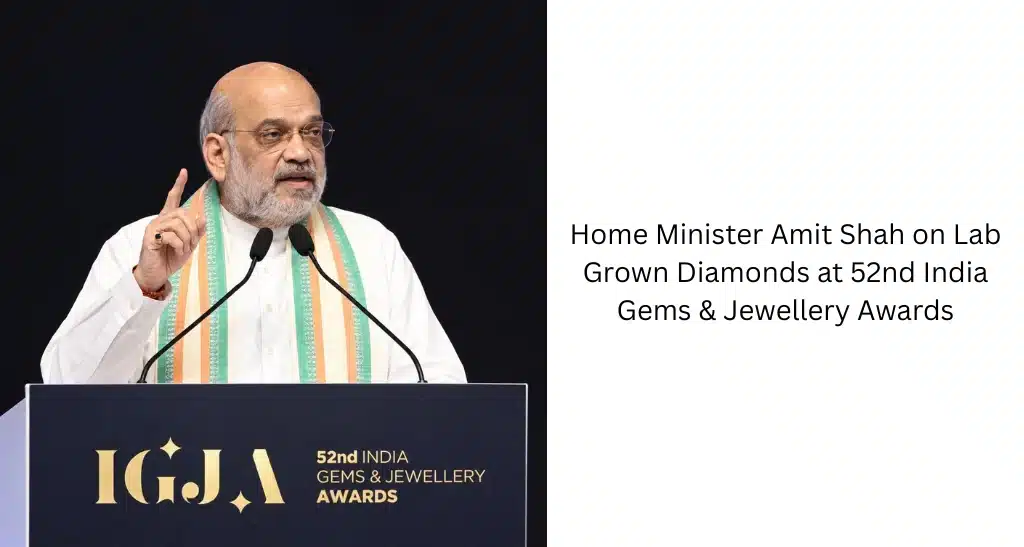
At the 52nd India Gem & Jewellery Awards, organised by the Gem & Jewellery Export Promotion Council (GJEPC), Union Home Minister Amit Shah stood in front of the people who cut, polish, design, and sell India’s diamonds — and told them their moment was arriving.
For an industry built on generations of quiet craftsmanship, being told your work could be 50 times bigger isn’t just a statistic. It’s validation.
Home Minister Amit Shah on Lab Grown Diamonds: What He Actually Said
Here’s the part that made headlines.
Speaking as Chief Guest at the awards, Amit Shah pointed to the growing shift in the global diamond trade — one where lab grown diamonds are no longer a side conversation, but a central one.
He suggested the lab grown diamond category could eventually reach close to 50 times the volume of today’s diamond market.
That number needs a little unpacking, because it’s easy to misread.
Volume, Not Value
The 50x figure Amit Shah referenced is about volume — the number of diamonds produced — not the total monetary value of the market.
This distinction matters. A market can grow massively in volume while growing more moderately in value, especially as lab grown diamond prices remain more accessible than natural diamonds.
Even so, a 50x volume shift represents an enormous opportunity, particularly for a country already positioned to produce, process, and sell at that scale.
Micro Story #1: The Jeweller Who Waited for This
A third-generation jeweller in Surat named Rajesh Bhai spent years watching younger buyers ask for lab grown options his shop didn’t stock.
He always felt behind, like the industry was moving somewhere he hadn’t been invited.
The day he heard about Amit Shah’s speech, he called his son and said, “Maybe it’s finally our time to stop hesitating.”
Amit Shah’s Bigger Message: Control the Entire Value Chain
The 50x number got the headlines. But the deeper message in Amit Shah’s address was about ownership — not just production.
He called on Indian jewellers and businesses to build capability across every part of the industry, not just one piece of it:
- Machinery for lab grown diamond production
- Growing and producing the diamonds themselves
- Cutting and polishing
- Crafting finished jewellery
- Building Indian brand names
- Opening Indian showrooms in global markets
This shifts the conversation. It’s no longer just about how many diamonds India can produce — it’s about how much of the value around those diamonds India can actually keep.
From Manufacturing Hub to Full Ecosystem
India has long been known as a manufacturing powerhouse for diamonds. What Amit Shah described is something bigger: an entire self-contained ecosystem, from raw machinery to a customer trying on a finished piece of jewellery in a store carrying an Indian name.
The full value chain looks something like this:
Machinery → Diamond Production → Cutting & Polishing → Jewellery Manufacturing → Branding → Retail → Global Markets
Why India Is Positioned for This Moment
There’s a quiet confidence in knowing you’ve already done the hard part.
India isn’t starting this journey from zero. The country has spent decades building the exact foundation this opportunity needs.
Surat has grown into one of the world’s largest diamond cutting and polishing centres. Mumbai has built a strong reputation in diamond trading and jewellery exports. Amit Shah specifically credited both cities as proof of what Indian businesses have already achieved on the global stage.
That means the next chapter isn’t about building something new from scratch — it’s about building on top of something India already does well.
Micro Story #2: The First Export Order
A small jewellery manufacturer near Mumbai remembers the first time her workshop shipped a box of finished pieces overseas.
She kept the shipping receipt in a drawer for years, not because it was valuable — because it reminded her the world was actually watching what they made.
Stories like hers are quietly common across India’s diamond hubs, and they’re part of why Amit Shah’s vision doesn’t feel far-fetched to the people already living it.
The Scale Already Behind India’s Gem and Jewellery Industry
This opportunity isn’t arriving into an empty room. India’s gems and jewellery sector is already a major economic force.
At the event, Amit Shah highlighted that India’s gems and jewellery exports reached approximately ₹2.44 lakh crore in 2025, with the sector supporting close to 75 lakh people through direct and indirect employment.
India already exports cut and polished diamonds and jewellery to major markets including the United States, Europe, West Asia, and Hong Kong.
Lab grown diamonds don’t need to build this network from the ground up. They can grow directly on top of it.
Government Support Behind the Vision
A vision this size needs more than encouragement — it needs policy support, and Amit Shah addressed that too.
He noted that the Union government is actively working on a dedicated policy framework for the lab grown diamond sector, with Gujarat and Maharashtra also developing their own state-level policies to support the industry.
This kind of backing matters most to the people taking the actual risk — small manufacturers deciding whether to invest in new machinery, designers deciding whether to build a lab grown diamond collection, exporters deciding whether to enter a new market.
Pain Points + Solutions
“This industry moves so fast, how do I keep up?”
If you’ve felt this way, you’re not imagining it. The shift from natural to lab grown diamonds has happened faster than many expected, and it’s normal to feel like you’re playing catch-up.
The solution: You don’t need to master everything overnight. Government-backed infrastructure — like the Bharat Ratnam Mega Common Facility Centre, which offers shared access to 3D printing, casting, and refining — exists specifically so smaller players don’t have to build every capability alone.
“Will Indian brands ever really compete globally?”
This is the quiet doubt behind a lot of manufacturing-focused businesses — the fear of always making things for someone else’s label.
The solution: Amit Shah’s call for Indian companies to open their own global showrooms is a direct answer to this doubt. The infrastructure and export experience already exist. What’s changing now is the ambition to own the brand, not just the production line.
“Is this 50x number even realistic, or just a big claim?”
Healthy skepticism is fair — big numbers get thrown around often in industry speeches.
The solution: Look at what’s backing the claim: existing manufacturing strength, growing global demand for accessible diamonds, and active government policy work already underway in multiple states. The number is ambitious, but it isn’t disconnected from what’s actually being built.
Micro Story #3: The Skeptical Buyer Who Changed Her Mind
A customer named Priya walked into a jewellery showroom expecting to feel unsure about lab grown diamonds.
She left wearing a ring she couldn’t stop looking at, and a receipt that cost less than she’d budgeted for a smaller natural stone.
“I didn’t buy it because it was cheaper,” she told the store owner later. “I bought it because it was beautiful, and I didn’t have to choose between beautiful and responsible.”
What This Infrastructure Push Really Means
Two projects mentioned in Amit Shah’s address stand out for what they represent, not just what they build.
The Bharat Ratnam Mega Common Facility Centre gives businesses shared access to modern manufacturing tools, including 3D printing, casting, and refining — capabilities that used to require major individual investment.
The India Jewellery Park represents a larger, longer-term commitment, with significant planned investment and employment potential for the sector.
Together, these projects lower the barrier for smaller manufacturers to compete at a technological level previously reserved for the largest players.
Why This Matters to You, Personally
If you work anywhere inside India’s gems and jewellery world — as a manufacturer, designer, retailer, or exporter — this isn’t a distant policy conversation. It’s a signal about where the next decade of opportunity is heading.
If you’re a customer choosing between natural and lab grown diamonds, this context matters too. You’re not choosing a lesser option. You’re stepping into a category your own country is actively positioning to lead globally.
Either way, this moment carries a quiet invitation: to stop watching the shift from a distance, and start being part of it.
How to Make Sense of This Opportunity
Step 1: Understand what “50x” actually means. It’s about volume potential, not an overnight value explosion. Plan around steady, sustained growth — not instant transformation.
Step 2: Look at the full value chain, not just one piece. Whether you manufacture, design, or sell, ask where you fit across machinery, production, cutting, branding, and retail — not just your current role.
Step 3: Pay attention to policy developments. Union, Gujarat, and Maharashtra policy frameworks are still forming. Early awareness means earlier advantage.
Step 4: Use available infrastructure. Facilities like the Bharat Ratnam Mega Common Facility Centre exist to help smaller businesses access tools they couldn’t otherwise afford alone.
Step 5: Think brand, not just product. Amit Shah’s message wasn’t only about making more diamonds — it was about India owning global jewellery brands. That applies whether you’re a manufacturer or a buyer choosing where to spend.
FAQs
1. What did Amit Shah say about lab grown diamonds? At the 52nd India Gem & Jewellery Awards, Amit Shah said the lab grown diamond market could grow to nearly 50 times the current market in volume, and called on Indian businesses to control the entire value chain, from machinery to global retail.
2. Is the lab grown diamond market really 50 times bigger? The 50x figure refers to potential volume growth, not value. It reflects the scale opportunity as lab grown diamonds become more widely produced and adopted globally.
3. Why is Surat important for India’s diamond industry? Surat is one of the world’s largest centres for diamond cutting and polishing, giving India a strong existing base to build a larger lab grown diamond ecosystem on top of.
4. What is India’s policy on lab grown diamonds? As of the announcement, the Union government is developing a dedicated policy for the sector, with Gujarat and Maharashtra also working on their own state-level policy support.
5. Are lab grown diamonds a good investment for India’s economy? Given India’s existing manufacturing strength, export relationships, and workforce of nearly 75 lakh people in the sector, the industry is well positioned to capture significant value from lab grown diamond growth.
6. What is the Bharat Ratnam Mega Common Facility Centre? It’s a shared manufacturing facility offering access to technologies like 3D printing, casting, and refining, helping smaller jewellery businesses access modern production tools.
7. What is the India Jewellery Park? It’s a major infrastructure development for India’s gems and jewellery sector, with significant planned investment aimed at boosting manufacturing capacity and employment.
8. How can Indian jewellery brands compete globally? By building capability across the entire value chain — from production to branding — and establishing their own showrooms internationally, rather than only manufacturing for other global brands.
Conclusion
Some speeches fade by the next news cycle. This one felt different, because it named something an entire industry had been quietly building toward for years.
India didn’t need permission to lead in this space. It needed someone to say it out loud, and point at the number.
If you’ve been building toward this moment — in a workshop, a design studio, or a small export business — that work wasn’t wasted while you waited.
You just found out the room is bigger than you thought.